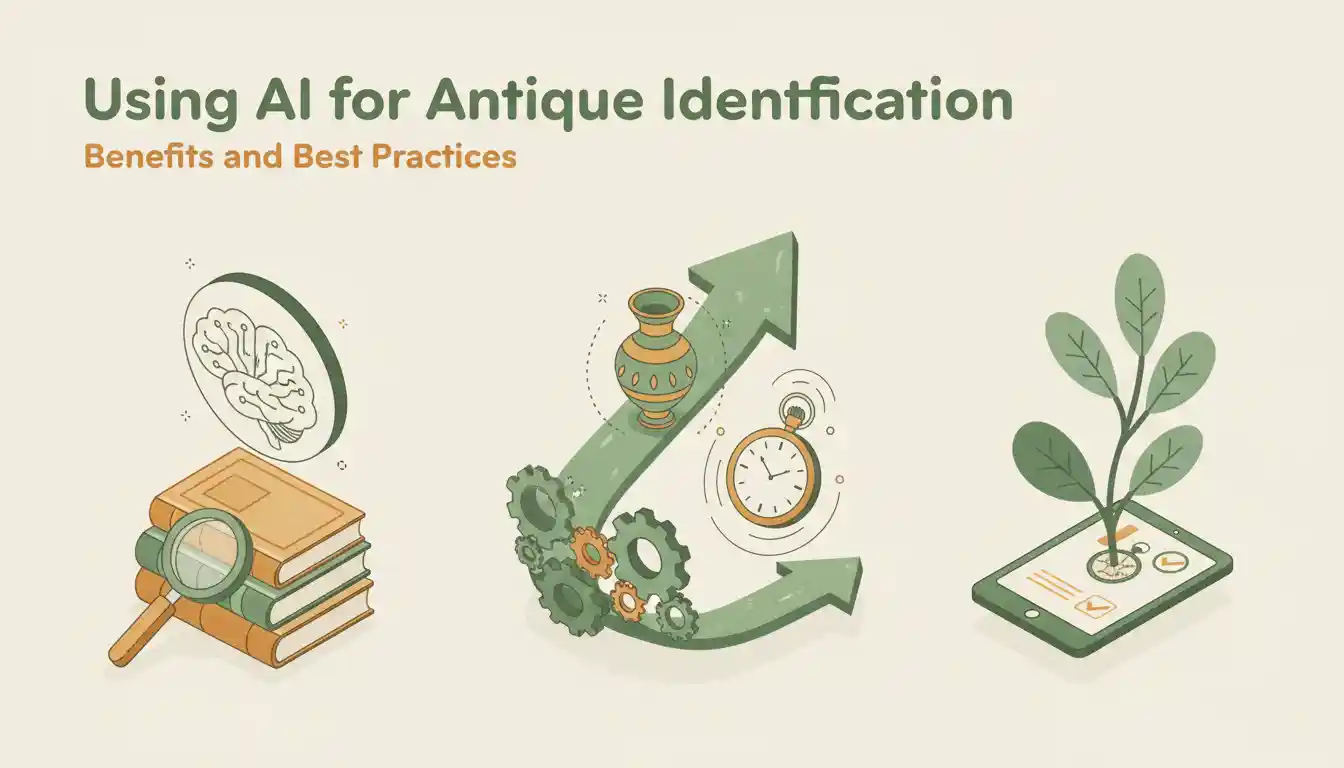
For generations, identifying an antique required an apprenticeship of the eye: handling thousands of objects, memorizing patterns and periods, and building a mental library through decades of experience. While that deep, tactile knowledge remains irreplaceable, a new tool has entered the collector's toolkit that is changing the game. Artificial Intelligence, specifically through sophisticated image recognition and vast database integration, is democratizing access to information and accelerating the learning curve. This isn't about a machine telling you what you have; it's about harnessing computational power to ask better questions, verify hunches, and uncover details you might have missed. Let's explore how to effectively partner with AI to become a more informed and confident collector.
The Transformative Benefits: How AI Augments the Collector's Journey
AI in antique identification isn't science fiction. It's a practical application of machine learning that offers concrete advantages, serving as a digital assistant that never tires and has a photographic memory of millions of reference items.
1. Democratization of Expertise and Accelerated Learning
The greatest barrier for new collectors is the sheer volume of information. AI shatters this barrier.
-
Instant Reference Library: Imagine having instant access to a searchable database of ten million marks, maker signatures, furniture joints, and glass patterns. An AI-powered app can provide just that. Point your camera at a blurry silverware mark, and the AI cross-references it against known hallmarks from London, Birmingham, and beyond, offering possible matches in seconds. This immediate feedback loop accelerates learning far faster than thumbing through a book.
-
Style Recognition and Period Guidance: For those still learning the difference between Art Nouveau and Art Deco, or Chippendale and Hepplewhite, AI can serve as a training wheel. By analyzing the lines, motifs, and proportions in a photo, it can suggest likely periods or styles, giving you a starting point for your own deeper research. It helps you build your visual vocabulary.
2. Enhanced Accuracy and Discovery of Obscure Details
The human eye is remarkable, but it can be tricked by forgery, fatigue, or simply missing a tiny detail.
-
Pattern Matching at Superhuman Scale: An AI model trained on thousands of examples of, say, Meissen porcelain crosses or Royal Doulton figurine marks, can detect subtle stylistic consistencies or anomalies that might escape even a seasoned expert. It can identify a pattern of pressed glass from a single partial motif or suggest a pottery maker based on the specific style of a painted floral brushstroke.
-
Uncovering the "Needle in the Haystack": Perhaps you have a piece with an unknown artist's monogram. Manually searching for it is daunting. AI can scan its database for similar symbols and characters, potentially connecting you to a niche studio potter or a regional silversmith whose work isn't covered in mainstream guides. It excels at these types of obscure, data-heavy tasks.
3. Efficiency and Confidence in the Field
The real test is in the noisy, crowded, and fast-paced environment of an auction preview or antique mall.
-
Real-Time Decision Support: When you have minutes to decide on a bid or a purchase, AI provides on-the-spot reconnaissance. Snap a photo of the furniture joinery, the ceramic mark, and the hardware. Get rapid data points on likely age, construction method, and maker. This doesn't make the decision for you, but it arms you with critical information to avoid obvious mistakes and focus on pieces with potential.
-
Documentation and Cataloging: For managing a collection, AI can help automate cataloging. Photograph an item, and the AI can suggest a descriptive title, period, and even help organize your items into digital categories, creating a searchable private inventory.
Essential Best Practices: Using AI as a Tool, Not an Oracle
The power of AI is real, but its utility is entirely dependent on how you use it. Misapplication leads to misinformation. Follow these principles to ensure AI serves you well.
1. The Golden Rule: AI is an Assistant, Not an Appraiser
This is the most critical mindset shift.
-
Verify, Don't Just Trust: Treat every AI suggestion as a hypothesis, not a conclusion. If an app identifies a chair as "18th Century Chippendale," use that as a starting point for your own physical examination. Check for the expected hand-cut dovetails, appropriate wood, and wear patterns. Corroborate the AI's hint with tangible evidence.
-
It Provides Data, Not Value: AI can suggest a maker or period, but it cannot assess provenance, condition, or current market sentiment to give a reliable value. Never use AI output as a substitute for a professional appraisal for insurance or sale purposes.
2. Master the Input: How to Take a "Good" Photo for AI
The quality of the answer depends entirely on the quality of your question. Garbage in, garbage out.
- Focus on Key Details: Don't just photograph the whole piece from afar. Give the AI clear, well-lit, head-on shots of the specific details you want identified.
- For marks: Get directly above the hallmark or signature, fill the frame, ensure even light to avoid shadows obscuring characters.
- For patterns: Capture a flat, straight-on shot of a repeating section.
-
For construction: Get clear shots of joinery, tool marks, or hardware from multiple angles.
-
Provide Context: Use apps that allow you to input multiple photos (full piece, detail, side view) and add your own notes (e.g., "wood feels light," "hinges appear replaced"). The more contextual data you provide, the more refined the AI's search parameters can be.
3. Use it as a Bridge to Deeper Learning
The goal is to use AI to graduate from needing it.
-
Follow the Breadcrumbs: When AI gives you a potential maker's name or pattern, don't stop there. Use that information to launch your own research. Read about that maker's history, their other works, and the hallmarks of their period. The AI provided the keyword; you must now write the story.
-
Cross-Reference with Traditional Resources: Use AI output to find the right page in a physical reference book or academic paper. This hybrid approach combining digital speed with analog depth is the most powerful method.
4. Choose Your Tools Wisely and Ethically
-
Look for Transparent Tools: Use applications that are clear about their data sources and limitations. A good tool, like Antique Identifier: Snap ID, is built specifically for this domain, with a database curated from reputable reference materials and museum collections, not just scraped from the open web.
-
Respect Privacy and Copyright: Be mindful when using AI tools in shops or at fairs. Always ask permission before photographing a dealer's inventory. Understand that the AI's knowledge is built on the work of scholars and institutions use it as a gateway to support and credit that original work through further study.
Conclusion: The Augmented Connoisseur
The future of antique collecting isn't a choice between human expertise and artificial intelligence; it's the synergistic combination of both. The seasoned connoisseur's eye for weight, patina, proportion, and feel the intangible "gestalt" of an object is something no algorithm can replicate. Conversely, no human can instantly recall every maker's mark used in Sheffield between 1820 and 1840.
By adopting AI as a field assistant, you free up your mental bandwidth to focus on higher-order analysis: judging aesthetic merit, understanding historical context, and sensing the story behind the object. You become an augmented connoisseur, leveraging the best of both worlds. Start by using AI to solve small mysteries a strange stamp, an unfamiliar motif. Let it build your confidence and knowledge base. But always, always let your final judgment be guided by your own educated senses and critical thinking.
Ready to experience this powerful partnership firsthand? Antique Identifier: Snap ID is designed from the ground up to function as your intelligent field assistant. Use it to decode marks, compare styles, and document your finds, following the best practices outlined here. Download Snap ID now and step into a new era of informed collecting, where technology amplifies your passion and knowledge.