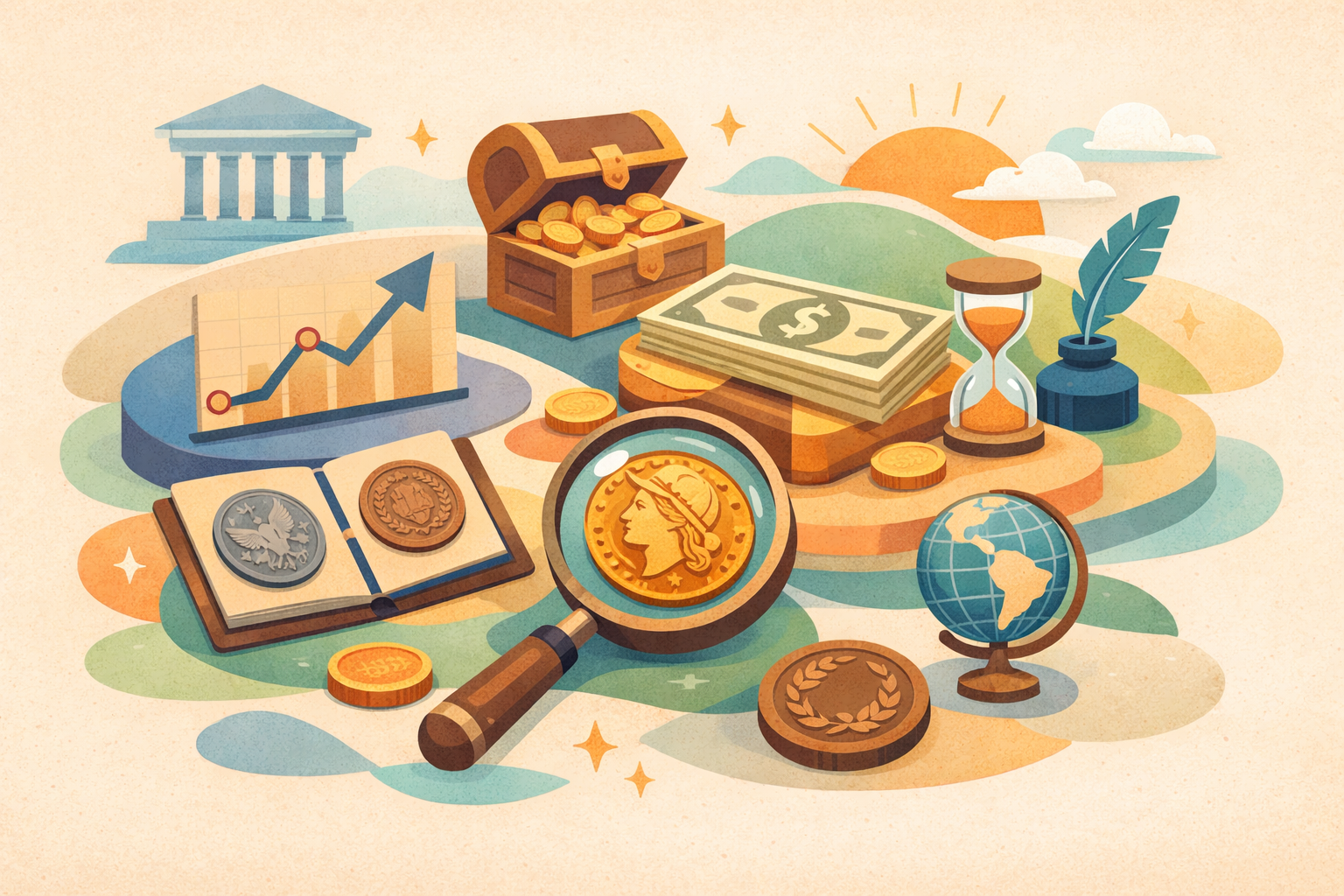
You’ve just found a handful of strange old coins in a dusty jar. One looks like silver. Another has a tiny letter you’ve never noticed. There’s even a wrinkled banknote with a red seal. Is it treasure or pocket change?
Most people freeze at this moment. They don’t know where to start. Should they clean the coins? Rub the paper? Call a dealer? And what if they accidentally ruin something valuable?
Here’s the good news: you don’t need a magnifying glass or a degree in numismatics to begin. This guide will teach you simple, visual clues to identify antique currency and coins right at your kitchen table. You’ll learn to spot mint marks, recognize silver, read paper currency red flags, and avoid the myths that cost beginners real money. And when you’re ready for instant answers, you can use a tool like Antique Identifier: Snap ID to identify and value your finds with just a photo.
Let’s turn that dusty jar into a detective story.
Why Coins & Currency Are Different from Furniture or Jewelry
If you’ve read our other guides on identifying furniture or ceramics, you might think antiques all work the same way. But coins and paper currency play by different rules. They’re tiny, mass-produced, and designed to be handled thousands of times. That means the clues you look for are unique.
- Metal composition changes over time – A penny today is mostly zinc. A penny from 1943 is steel. A quarter before 1965 is 90% silver. These shifts create instant visual giveaways.
- Wear patterns are intentional – Coins wear down from circulation, but the pattern matters. A genuine old coin loses detail on the high points (like a king’s cheek or an eagle’s wing). A fake often has unnatural, scratchy wear.
- Edge lettering and reeding contain hidden clues – Some coins have plain edges, others have reeded (grooved) edges, and a few even have lettered edges (like “E PLURIBUS UNUM”). This helps identify the origin and era.
- Paper currency uses specific fibers, inks, and printing methods – Old bills weren’t printed on the same paper as today. They contain tiny red and blue fibers. The inks, serial number fonts, and seal designs all changed over decades.
What Circulation Wear Tells You
Take a close look at the highest points of a coin – the raised design. If they’re smooth and flat but the background fields are still relatively clean, that’s honest circulation wear. The coin has been passed from hand to hand for decades. That’s a good sign of age. But if the wear looks uneven, with deep scratches in some areas and untouched detail in others, be suspicious. Someone may have artificially “aged” the coin.
What you can do: Compare the coin’s high points to a known modern coin. If the old one feels noticeably flatter but still has sharp edges around the rim, you’re likely looking at genuine circulation wear.
The Secret Language of Edges
Pick up any coin and look at its edge – not the front or back, but the thin side. You’ll see one of three things:
- Reeded (grooved) – Common on U.S. dimes, quarters, and half dollars. The grooves helped prevent people from shaving off silver.
- Plain (smooth) – Found on pennies, nickels, and many world coins.
- Lettered – Rare. Some old U.S. dollars and half dollars have phrases like “FIFTY CENTS OR HALF A DOLLAR” stamped into the edge.
If you have a coin with a lettered edge, you’ve found something special. That’s a strong clue it’s from the 18th or early 19th century.
Reading the Language of a Coin – Mint Marks, Date Styles, and Designer Initials
Every coin tells a story. You just need to learn its alphabet. Three features give you the most information in under ten seconds: the mint mark, the date style, and the designer initials.
- Mint marks – A tiny letter (D, S, CC, P, or O) that tells you which mint produced the coin. This can dramatically affect rarity.
- Date font and spacing – Older coins often have serif numerals that look different from modern, cleaner fonts. Also, the spacing between numbers can change (e.g., a “1 9 0 9” that’s widely spaced vs. a tight “1909”).
- Designer initials – Hidden somewhere on the coin. The famous “V.D.B.” on the back of 1909 Lincoln cents (near the rim at the bottom) is a classic example.
- No mint mark? That’s also a clue – For most U.S. coins, no mint mark means it was made in Philadelphia. But on certain issues (like the 1922 Lincoln cent), the lack of a mint mark is a major rarity.
Mint Mark Location Cheat Sheet
Here’s a quick reference for U.S. coin mint marks. Find the mark, look up the location, and you’ll know where your coin was born.
| Mint Mark | Mint Location | Active Years (for most coins) |
|---|---|---|
| (none) | Philadelphia | 1793–present (except 1942-45 silver nickels) |
| D | Denver | 1906–present |
| S | San Francisco | 1854–present (with gaps) |
| CC | Carson City | 1870–1893 (very collectible) |
| O | New Orleans | 1838–1909 |
| P | Philadelphia (modern) | 1980–present (on some denominations) |
What you can do: Find the mint mark (usually near the date on the front, or on the back near the rim). Compare it to the table. If you see “CC” or “O,” you’ve got a coin with a great story.
Why a Missing Mint Mark Can Be Valuable
Here’s a fun twist. Sometimes the absence of a mint mark is the prize. Take the 1922 Lincoln cent. All cents that year were supposed to be made in Denver (with a “D” mint mark). But a few dies were worn down, and the “D” didn’t stamp properly. The result? A 1922 “no D” cent. It’s worth hundreds or even thousands of dollars in good condition.
Real-world example: Check your wheat pennies. If you find a 1922 cent with no visible mint mark on the front (just below the date), don’t spend it. Get it authenticated.
Quick Wins – Recognizing Silver, Clad, and Wheat Pennies
You don’t need to be an expert to spot the big wins. These three quick checks will help you sort the “maybe valuable” from the “definitely ordinary” in less than a minute.
- Silver edge test vs. clad sandwich edge – Look at the edge of a dime, quarter, or half dollar dated 1964 or earlier. You’ll see a solid silver color all the way through. Coins from 1965 onward (except special issues) have a clad edge – a copper-colored stripe sandwiched between two layers of nickel.
- Wheat pennies (1909–1958) vs. Lincoln Memorial cents – Flip a penny. If you see two stalks of wheat on the back, it’s a wheat penny. If you see the Lincoln Memorial, it’s modern (1959–present). Wheat pennies are older and generally more collectible.
- War nickels (1942–1945) – During WWII, nickel was needed for armor. So the U.S. made nickels with 35% silver. You can spot them easily: look above Monticello on the back. If you see a large mint mark (P, D, or S) right above the dome, you’ve got a war nickel. They have a distinctive grayish tone and stick to a magnet differently.
- IKE dollar vs. silver eagle – Large dollars from 1971–1978 (Eisenhower dollars) are usually clad, not silver. But some were struck in 40% silver for collectors. The quick tell? Weight. A silver IKE feels noticeably heavier, and its edge has no copper stripe.
The Simple Drop Test
Hold a coin by its edge between your thumb and forefinger. Tap it lightly on a hard surface (like a glass table or a ceramic plate). A silver coin rings – a clear, high-pitched tone that fades slowly. A clad coin thuds – a dull, short sound that dies immediately. This works best on dimes, quarters, and half dollars.
What you can do: Try it with a modern quarter (clad) and any pre-1965 quarter (silver). You’ll never mistake the sound again.
3 Seconds to Spot a Key Date
Some dates are famous for being rare. You don’t need to memorize a hundred numbers. Just learn these three:
- 1909-S VDB – The holy grail of wheat pennies. “S” mint mark + “VDB” initials on the back.
- 1916-D dime – A Mercury dime with a “D” mint mark. Very rare.
- 1943 copper cent – Most 1943 cents are steel (gray and magnetic). If you find a copper-colored one, it’s an ultra-rare error worth six figures.
What you can do: Scan your wheat pennies for 1909, 1914, 1922, 1931, and 1955. Those years have valuable varieties.
Paper Currency Red Flags – Serial Numbers, Seals, and Watermarks
Paper money is a whole different game. It’s fragile, easy to fake, and packed with tiny details. But once you know what to look for, you can spot an old bill from across the room.
- Serial number font changes – Old bills (pre-1920s) have blocky, uneven numbers that look almost hand-stamped. Modern bills have crisp, computer-generated fonts. If the serial numbers look too perfect, the bill might be a reproduction or a later issue.
- Seal colors – This is your biggest clue. Green seals are standard (Federal Reserve Notes). Red seals mean United States Note (old, often 1928–1966). Blue seals indicate Silver Certificate (redeemable for silver). Gold seals (very rare) are Gold Certificates. Brown seals were used for National Bank Notes and WWII Hawaii notes.
- Watermark placement and clarity – Hold the bill up to light. Older bills (before 1996) generally don’t have watermarks. When they appear, the watermark matches the portrait. If the watermark is missing, blurry, or doesn’t match, be suspicious.
- Misalignments and overprints – Errors on paper money can be valuable. Look for serial numbers that are upside down, seals that are shifted, or cuts that are way off-center.
Red Seal vs. Blue Seal – What’s the Difference?
A red seal means you have a United States Note. These were issued directly by the government from 1862 to 1971. They’re less common today and can carry a premium, especially in crisp condition.
A blue seal means a Silver Certificate. From 1878 to 1964, you could take these bills to a bank and exchange them for silver dollars or bullion. They often feature interesting back designs (like the famous “Morgan” silver dollar on some large-size notes).
What you can do: Flip through any old bills you have. If you see a red or blue seal, set it aside. It’s at least worth keeping, and sometimes worth much more.
How to Spot a Counterfeit from 50 Years Ago
Old counterfeits are a real problem. Before modern security features (color-shifting ink, embedded strips, microprinting), forgers had an easier time. Look for these three red flags:
- No red/blue fibers – Genuine U.S. currency has tiny red and blue fibers scattered in the paper. A counterfeit often lacks them entirely or has fibers printed on the surface.
- Blurry printing – Real bills have sharp, fine lines. If the portrait looks mushy or the border lines bleed together, it’s probably fake.
- Wrong paper feel – Old bills are printed on a special cotton-linen blend. They feel crisp and slightly rough, not slick like copy paper.
How to Photograph Coins & Currency for Better AI Identification
You’ve identified some promising clues. Now you want a second opinion – fast. That’s where AI identification comes in. Apps like Snap ID can analyze your photo and give you an instant identification, estimated age, and even value trends. But the app is only as good as your photo.
- Lighting – Use natural, indirect daylight. Place your coin or bill near a window on a cloudy day. Never use flash – it creates glare that hides details.
- Both sides required – For coins, photograph the front (obverse) and back (reverse). For paper currency, do the same. The AI needs both to match the design.
- Include a scale reference – Lay a ruler next to the coin, or photograph it next to a common coin (like a modern quarter). This helps the AI understand size.
- Paper currency – Lay it completely flat. Use a piece of glass or a heavy book to flatten curled notes. Avoid shadows by angling your light source from the side.
The 3-Shot Rule
Don’t just snap one picture. Take three:
- Full coin – The entire coin centered, filling most of the frame.
- Close-up of the date – Get in tight so the date and mint mark are crystal clear.
- Close-up of any unusual feature – A strange edge, a die crack, or a designer initial.
For paper currency: full front, full back, and a close-up of the serial number and seal.
Why Not to Clean Before Photographing
This is the most important rule in antique collecting. Do not clean your coins or currency. Not with water. Not with a cloth. Not with baking soda or vinegar or any “quick shine” trick you saw online.
Cleaning destroys the natural patina – the layer of oxidation that gives old coins their character. A cleaned coin is often worth less than half of an uncleaned one. Dealers can spot cleaning instantly under magnification. Paper currency is even worse: rubbing it smears inks, breaks fibers, and can turn a $100 note into a $5 rag.
What you can do: If a coin is dirty with loose grime, soak it in pure acetone (not nail polish remover) for a few minutes, then air dry. Never rub. For paper, do nothing. Leave the dirt. It’s part of the history.
Common Myths – “Old = Rare” and Other Traps
You’ll hear a lot of advice from well-meaning friends and internet forums. Most of it is wrong. Let’s bust the biggest myths right now.
- Old does not equal valuable – That 1880s British penny? They made millions. In worn condition, it’s worth a dollar. Age alone means nothing without rarity and demand.
- Damage ≠ character – A hole drilled into a coin for a necklace? A deep scratch? A bent edge? That’s damage, not “character.” It kills value. Collectors want problem-free coins.
- Foreign coins can be both ancient and worthless – Roman coins from the late empire were minted in such huge numbers that common ones sell for $10–20. Yes, they’re 1,600 years old. No, you’re not retiring.
- “Error” coins are rarely valuable unless dramatic – A slightly off-center strike? Minor die chip? Worth maybe $5. A coin that’s missing the entire front layer? Now we’re talking. Most errors are tiny and unexciting.
The “Grandpa’s Drawer” Fallacy
Everyone has heard the story: “Grandpa left me a jar of old coins. I bet they’re worth a fortune.” Nine times out of ten, they’re common date wheat pennies, worn Mercury dimes, and silver halves from the 1940s. Nice silver value (melt), but nothing rare. Sentiment is wonderful. Market value is separate.
What you can do: Enjoy the family history. But don’t quit your day job.
When “Worthless” Actually Isn’t
Now for some hope. Sometimes a coin that looks ordinary is hiding a secret. A 1943 steel cent in pristine condition (uncirculated) can be worth hundreds. A worn 1916-D dime is still worth thousands. A 1955 doubled-die penny (looks blurry) can be a five-figure coin.
The trick is to learn the handful of real rarities. Our advice? Use an AI identifier like Snap ID to scan every coin in that jar. Let technology catch what the naked eye misses.
Conclusion
You don’t need to be a professional numismatist to start identifying old coins and paper currency. Start with your eyes. Look for the mint mark. Check the edge – reeded, plain, or lettered? Test the sound – ring or thud? For paper, spot the seal color – red, blue, or green? And never, ever clean anything.
Once you’ve gathered your visual clues, take clear photos – natural light, both sides, scale reference. Then let modern AI do the heavy lifting.
Your next step: Download Antique Identifier: Snap ID today. Snap a photo of that mysterious coin or old banknote, and get answers in seconds – without the guesswork. Whether it’s a wheat penny from your grandpa’s drawer or a red-seal dollar from a flea market, you’ll finally know what you’re holding.
And who knows? That dusty jar might just hold a treasure after all.